
Western Balkans: The ageing workforce challenge



The Western Balkans face significant demographic and structural imbalances in their labour markets, with some economies struggling to mobilise older workers while others rely heavily on people beyond retirement age to address labour shortages. At the same time, high levels of youth inactivity remain a major obstacle to productivity growth and economic convergence with the European Union.
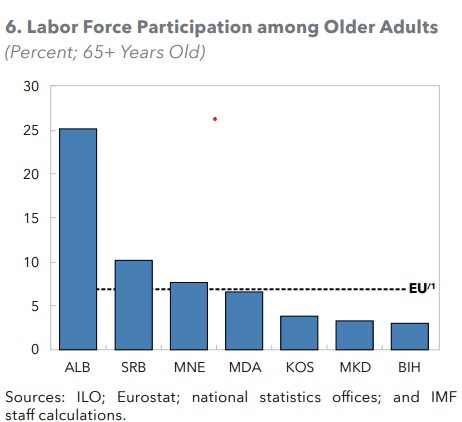
Data analysed by the International Monetary Fund (IMF) reveal substantial disparities in labour force participation among people aged 65 and over across the region.
Albania stands out, with a participation rate exceeding 25%, more than three times the EU average and significantly above that of the other five Western Balkan economies. Labour shortages, insufficient pensions relative to the cost of living and an economic structure dominated by low-skilled jobs are among the factors keeping older Albanians economically active for longer.
Serbia follows at around 10%, while Montenegro records a rate of slightly below 8%, compared with the EU average of approximately 7%.
Among other European economies covered by the analysis, Moldova records a participation rate of around 6.5%–7%. Kosovo stands at approximately 4%, followed by North Macedonia at slightly above 3% and Bosnia and Herzegovina at around 3%.
For Kosovo, North Macedonia and Bosnia and Herzegovina, increasing the participation of older workers represents an opportunity to expand the available workforce, particularly as demographic pressures and emigration constrain labour supply. Albania, by contrast, already relies heavily on older workers.
High youth inactivity remains a regional challenge
The Western Balkans also face significant challenges at the opposite end of the age spectrum.
Albania, Kosovo and North Macedonia record shares of young people not in employment, education or training (NEET) exceeding 20%.
The high proportion of economically inactive young people represents a considerable loss of human capital, limiting the region’s productive potential at a time when businesses are increasingly struggling to recruit workers.
Albania presents a particularly striking contrast, combining the region’s highest labour force participation among older people with persistently high levels of youth inactivity.
Labour market reforms and EU convergence
According to the IMF, addressing these structural imbalances and bringing labour market performance closer to EU standards requires reforms focused on facilitating the transition from education to employment and improving the quality of human capital.
Expanding apprenticeship and internship programmes, strengthening cooperation between educational institutions and employers, and improving career guidance could facilitate young people’s entry into the labour market.
At the same time, better aligning labour supply with employers’ needs remains critical to boosting productivity and addressing skills mismatches across the Western Balkans.
Priority areas include strengthening vocational education and training, modernising curricula with greater emphasis on STEM disciplines (science, technology, engineering and mathematics), and expanding reskilling and lifelong learning programmes, including for workers in the middle and later stages of their careers.
As demographic pressures intensify, the Western Balkans’ ability to mobilise underutilised human capital and improve workforce skills will be increasingly important for sustaining economic growth and narrowing the development gap with the European Union.
Ky është artikull ekskluziv i Revistës Monitor, që gëzon të drejtën e autorësisë sipas Ligjit Nr. 35/2016, “Për të drejtat e autorit dhe të drejtat e lidhura me to”.
Artikulli mund të ripublikohet nga mediat e tjera vetëm duke cituar “Revista Monitor” shoqëruar me linkun e artikullit origjinal.